
When it applies, what notice you owe your neighbour, how disputes get settled, and the parts most guides quietly skip.
Quick answer & Take Aways
- The Party Wall Act 1996 deals with three matters: constructing a new wall on the boundary, performing works to an adjacent (party) wall and digging near a neighbour’s property line. If your project includes any of these, you are required to inform the neighbour in writing beforehand.
- Notice periods are fixed by law: two months for work to an existing party wall, and one month for a new boundary wall or for excavation work. The notice stays valid for one year.
- Your neighbour has 14 days to respond in writing. Silence counts as dissent, which means a dispute, which means surveyors.
- A neighbour cannot stop work that the Act permits. They can only influence how and when it is done, and they are entitled to have any damage put right.
- The Act applies only in England and Wales. It does not touch Scotland or Northern Ireland.
Planning a loft conversion, a rear extension, a basement, or even just cutting into the wall you share with the next door? Before a single brick moves, there is a law you need to deal with. Get it right, so that your project runs smoothly. Get it wrong, and a neighbour can take you to court and stop the job dead.
From SurveyOne in Stoke-on-Trent, UK : This guide takes you through the full text of the Party Wall Act 1996 in order: what it sets out to do, when you need to comply with it, and how much you owe your neighbour for what right? No jargon for its own sake. Only the parts that alter what you do next.
What is the Party Wall Act 1996 Stoke-on-Trent, UK & What Does It Actually Do?

The Party Wall Act 1996 is the law that allows you to carry out certain building work affecting a neighbour’s property while protecting that neighbour from damage and disruption. It came into force on 1 July 1997 and applies across England and Wales. It does not transfer ownership of anything, nor does it decide where your boundary lies. It simply sets the rules of engagement.
This is the mental model that would help. The Act was enacted to facilitate building work, not hinder it. In exchange for the right to do work that straddles the boundary of two properties, you have a duty: properly warn your neighbour, cause them no unnecessary inconvenience and make good any damage you cause. The trade is this whole spirit of the thing.
There’s one detail that trips people up all the time. The definition of an “owner” in the Act is broader than you might think. This encompasses freeholders, leaseholders with over a year remaining on their title, anyone who is in contract to purchase any such title, and anyone who, within that, rents, all of whom will be payable by a person. Therefore, a household might consist of more than one “owner”, and you must inform all of them. Get one wrong, and it may not stand.
Does the Party Wall Act 1996 Apply to My Project In Stoke-on-Trent, UK?

Three categories of work bring you under the Act. Building a new wall up to or even astride the boundary. Doing work to an existing party wall or structure, such as cutting in a beam, underpinning, raising it, or taking it down and rebuilding. And excavating near a neighbour’s building, within three metres and deeper than their foundations, or within six metres on a downward 45-degree line from their foundations.
If you’re in any of those roles, you need to determine whether the Act applies and, if so, give notice. Examples of exempt work: a loft extension on one side where no steel beams are stacked on the neighbouring wall; a rear extension abutting the neighbouring wall; a basement dig; chimney breast removals that take projection off the party wall.
Some tasks are so trivial that they don’t even warrant a glance. So drilling to put in some shelves or a wall unit, changing, for example, a socket, which is, in most cases, subject to gradual obsolescence, removing it and re-skimming. This test is straightforward: did the work impact how sturdy or load-bearing the wall is, or damage your neighbour’s side of it? If yes, consider it notifiable. If you are even half-uncertain, get a view before you go, not after.
The Three Notices at a Glance & Legal Complications
Each type of work has its own notice and its own minimum warning period. This is where many homeowners come unstuck, because they assume every notice needs two months’ notice. It does not.
| Line of Junction Notice (Section 1) | A new wall built up to, or astride, the boundary line between two properties. | A new boundary wall, or the flank wall of a new extension on the line. | 1 month |
| Party Structure Notice (Section 2) | Work to an existing shared wall or structure. | Loft conversion beams, underpinning, raising the wall, rebuilding, chimney breast removal. | 2 months |
| 3 or 6 Metre Notice (Section 6) | Excavation near a neighbour’s building, by depth and distance. | Basement digs, deep foundations for an extension. | 1 month |
Source: The Party Wall etc. Act 1996 explanatory booklet, gov.uk. Notice periods are statutory minimums; the notice is valid for 1 year from the date of service.
One project can trigger multiple notices. A rear extension with deep foundations that also ties into the party wall, for instance, may need both a Section 2 and a Section 6 notice. They can be combined into a single, properly worded letter.
Going deeper: the exact wording, who signs, and how to serve each one are their own subjects. See the dedicated page on party wall notices (surveyone.co.uk/party-wall-notices) for the details and example letters.

The Party Wall Act 1996 process and notice periods at a glance. Figures from the gov.uk explanatory booklet.
How Much Notice Time Do I Have to Give My Neighbour?
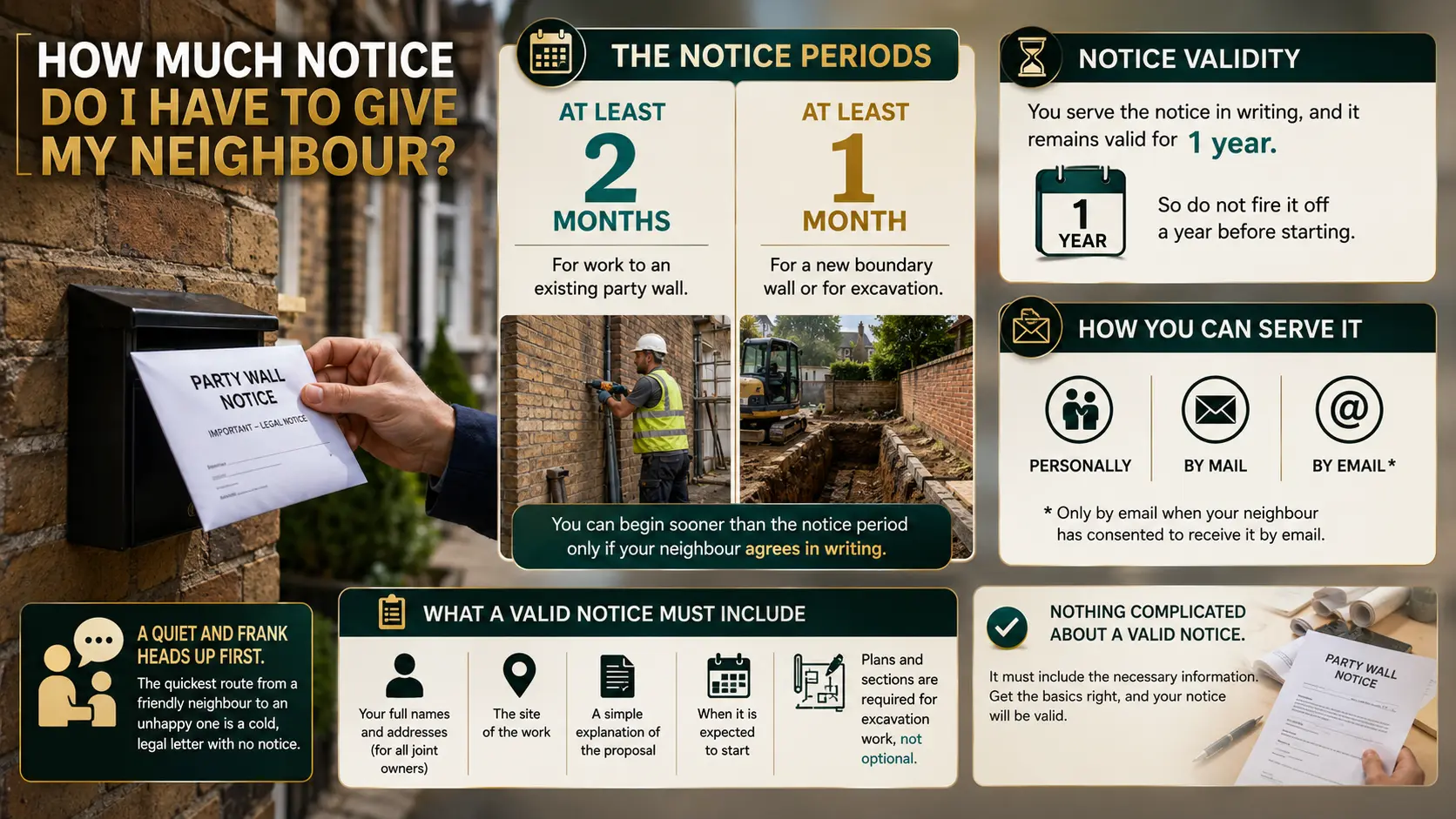
At least two months for work to an existing party wall, and at least one month for a new boundary wall or for excavation. You serve the notice in writing, and it remains valid for 1 year, so do not fire it off a year before starting. You can begin sooner than the notice period only if your neighbour agrees in writing.
There is nothing comic complex about a valid notice. However, it must include the necessary information: your full names and addresses (for all joint owners). The site of the work, a simple explanation of the proposal and when it is expected to start. Plans and sections are required for excavation work, not optional.
You can serve it personally, by mail, or email—again, only by means of email when your neighbour has consented to receive it through that vehicle. Everybody doing this for a living will give you the avoidable, common sense angle: A quiet and frank heads up with your neighbour ahead of the notice landing. The quickest route from a friendly neighbour to an unhappy one is a cold, legal letter with no notice.
What Happens After You Serve a Party Wall Notice in Stoke-on-Trent, UK?
Your neighbour has three options for Party wall notices in Stoke-on-Trent, UK. They can put in writing what they agree with, which means you are good to go. They can prosecute instead of the surveyor process getting invoked. Or they can sit on their hands, at which point (at the end of 14 days), silence is construed as a dispute by law. You are also trained not to let a no-reply neighbour stall you forever. All it does is put you on the official path.
Whatever you agree on, make sure it’s in writing. Consent is not a license to do whatever you like. So what if the neighbour says yes, you still owe the same duties. Do not burden them; protect their property where required, and make reparation for any damage. Zero-sum gambling. As for consent, it means there is nothing in dispute at the moment. The formal process can still be triggered if surfaces are damaged later.
What If My Neighbour Ignores the Notice or Says No?

A dissent or a non-response puts you “in dispute” under the Act, and the route out is a surveyor. You and your neighbour can jointly appoint a single impartial “agreed surveyor,” which is cheaper and quicker. Or you each appoint your own, and the two of you pick a third to hold in reserve in case you disagree. Either way, the surveyor’s job is to be impartial, not to fight your corner.
But you are not trapped if your neighbour refuses to engage at all, or even with a ‘surveyor’s choice. Meaning you can set a surveyor for them, and it should go ahead without them. The way the Act is written means no uncooperative party can individually freeze any lawful project forever.
What is a Party Wall Award in Stoke-on-Trent, UK, and Who Pays for It?

A party wall award is the final legal document that the surveyor issues to resolve a dispute. It sets out exactly what work will be done, how and when, what protective measures are needed, and, usually, the condition of the neighbour’s property beforehand. As a rule, the building owner who wants the work pays the costs, including the neighbour’s surveyor’s fee, when the work is for their benefit.
The award is binding once served. Either owner then has 14 days to appeal it to the county court, which is not a step to be taken lightly. There are no fixed surveyor fees set by law; they are negotiable, and a surveyor must charge only reasonable costs. Because pricing depends heavily on the job, the route, and how cooperative everyone is, it has its own page rather than being here.
The Schedule of Conditions: Small Step, Huge Protection
The condition of the neighbour’s property is usually documented in writing and with photographs by a surveyor before work begins. Below we include the schedule of conditions. The important thing to note is that it isn’t a legal obligation under the Act. But it is also the most valuable piece of paper in the entire process, because if a hairline (fracture) shows up after this point, it is what determines that your work did or did not create it.
Worth its weight: more on why this document matters, and what a good one looks like, on the schedule of condition page (surveyone.co.uk/schedule-of-condition).
| WHAT MOST GUIDES WON’T TELL YOU Most articles frame the Party Wall Act as a way for neighbours to block your build in Stoke-on-Trent, UK. It is the opposite. The Act gives you rights to do the work; a neighbour cannot stop something the Act permits, they can only shape how and when it happens. The real teeth lie elsewhere. The Act has no enforcement mechanism of its own. If you skip the notice and start anyway, your neighbour’s remedy is a court injunction, which can halt your project mid-build. So the notice is not bureaucratic box-ticking. It is the thing that keeps you out of court. |
What the Party Wall Act 1996 Does Not Cover in Stoke-on-Trent, UK

The Act is more limited than most people assume. It does not alter the ownership of a wall, nor does it shift a line. Importantly, it cannot settle a line-drawing dispute: if the real debate is over where a line goes, then this Act is not intended for that purpose. This also has nothing to do with planning consent and building controls. It could be all three at once for you.
That separation catches people out. Planning permission does not exempt you from serving a party wall notice, and the serving of notice does not excuse you from building control. They are parallel tracks, and you need to get through every track.
It also does not police general annoyances. Excessive noise, dust, and the like are matters for your local authority’s environmental health team rather than the party wall process. And if excavation work carried out outside the Act causes damage to your property, common law and, potentially, the courts are again your remedy, not a party wall award.
How the Party Wall Act 1996 Works Across England and Wales
The Act is the same up and down England and Wales, even if it runs from a terraced street in London to a semi in Cardiff. It does not actually apply in Scotland or Northern Ireland, where neighbour building work is governed by different rules. We tell you how the same notice periods, a 14-day window, and the surveyor process apply, no matter where in England and Wales you are.
What changes from place to place is not the law but the housing. Dense Victorian and Edwardian terraces, the kind that fill so much of urban England and Wales, share walls along their entire length, so almost any structural work touches a party wall. Newer detached and semi-detached stock may only bring the Act in for boundary or excavation work. The legal duty is constant; how often it bites depends on where you live.
If you want a starting point that is not a commercial pitch, the government’s own explanatory booklet on the Party Wall etc. Act 1996 (gov.uk/guidance/party-wall-etc-act-1996-guidance) is the plain-English source this guide is built on.
What to Do Next, and Surveyone for Your Help Near You in Stoke-on-Trent, Uk
Decide which of the three categories applies to your project. This will determine your notice period: two months for an existing party wall, and one month for a new boundary wall or ground excavation. Talk to your neighbour before anything official comes through their letterbox, then. An unstructured and informal conversation today prevents us from having a formal debate tomorrow. And if the work affects a party wall in any structural sense, book a condition survey before day one on site so you have coverage for anything that moves. This guide is general information about the Party Wall Act 1996 for homeowners in England and Wales, based on the gov.uk explanatory booklet. It is not legal advice and does not cover every situation. For your own project, take advice from a qualified party wall surveyor or solicitor.
We at Surveyone Stoke-on-Trent, UK, help you in the best way possible. From Surveying to party wall awards or notices and keeping the records. Contact Us and book a consultation for your property and your rights.
Party Wall Act 1996: frequently asked questions

Can I serve the party wall notice even myself, or do I need a surveyor?
You can serve it yourself. There is no requirement to use a professional to give notice, and no official form is required. That said, a poorly worded or incomplete notice can be challenged as invalid, which costs you time. Many people draft it themselves for a friendly neighbour and bring in a surveyor only if a dispute arises.
I already have planning permission. Do I still need to bother with the Act?
Yes. Planning permission, building regulations, and the Party Wall Act are three separate things. Clearing one does not clear the others. You can have full planning consent and still be legally required to serve a party wall notice before you start.
My neighbour says the Act will settle the location of our boundary. Will it?
No. The Act does not determine boundaries or change ownership of a wall. If the genuine disagreement is about where the boundary line runs, that is a separate matter for the courts or for alternative dispute resolution, such as mediation. A party wall surveyor cannot rule on it.
What if my neighbour starts building without serving me a notice?
The Act has no built-in penalty for failing to serve notice because it is civil law, not criminal law. Your practical remedy is to seek a court injunction to stop the work, or other legal redress. It is worth taking professional or legal advice before going down that road.
Is a schedule of conditions legally required?
No, it is not a requirement of the Act. But it is strongly advised. Without a record of your neighbour’s property before work began, it can be very hard to prove later whether your work actually caused a crack or other damage.
There are several flats next door. Who do I serve?
All of them, in effect. “Owner” under the Act includes freeholders, leaseholders with over a year remaining, people under contract to buy, and those entitled to rent. Where a property or neighbouring properties have more than one owner, it is your duty to notify every one of them.
How long is a party wall notice valid once I serve it?
One year from the date it is served. So there is no advantage to serving it far in advance. Serve it close enough to your real start date that it is still live when the work begins.
Can party wall notices and replies be sent by email?
Yes, but only if the recipient consented to receive them by email, has not withdrawn that consent, and has an email address. If not, then serve by post or in person and obtain evidence of service.
If a dispute drags on, can my neighbour stop my extension entirely?
Not if such work is permitted by the Act. An adjoining owner, therefore, can not prevent lawful works; he or she (the Adjoining Owner) only has control over when and how these will take place, is able to insist upon protection measures that help reduce the impact on their property and is entitled to compensation for their loss or damage. The dispute process concerns not whether the work can happen, but rather how it is done.
If I sell my house, do I have to disclose a past party wall dispute to the buyer?
Quite possibly. The property information forms completed during conveyancing may include questions about the Act, such as whether there has been a dispute. Your conveyancer will guide you on what to disclose.